


SLC Agrícola, the world’s largest farming group, is expanding its push into cattle, highlighting how Brazil’s productivity gains have helped propel the country to the top of global beef production.
What started in 2018 as a small-scale operation has grown into a business spread across seven farms in Mato Grosso and Mato Grosso do Sul. The company sold more than 60,000 head of cattle last year and expects to market 78,000 animals in 2026, Chief Executive Officer Aurélio Pavinato said in an interview.
The numbers remain small relative to SLC’s core grain operation, which spans more than 800,000 hectares and generates over 8 billion reais ($1.6 billion) in annual revenue.
Even so, growth has been fast. Livestock revenue reached 383 million reais in 2025, up nearly 90% from a year earlier, and could approach 500 million reais this year, supported by expansion and firmer cattle prices.
The strategy is built on extracting synergies with crop farming while improving land use. Areas with sandier soils — less suitable for soybeans — have been converted into permanent pasture, totaling about 8,000 hectares.
Beyond that, SLC operates two feedlots in Mato Grosso do Sul and fattens cattle as a “third crop” following the second corn harvest, adding 9,300 hectares through an integrated crop-livestock system. In this model, cattle are fed both pasture and grain, leveraging the company’s own feed production.
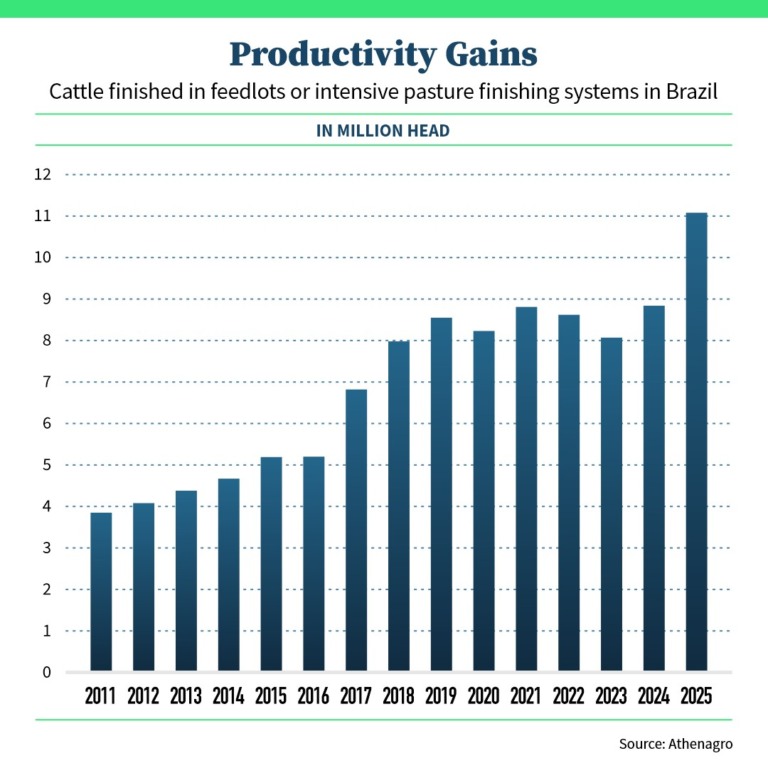
The approach is also delivering agronomic benefits. Fields planted with brachiaria grass and used for grazing have shown higher soybean yields in the following season compared with non-grazed areas, according to Pavinato.
Margins in cattle ranching remain below those of grain farming, with livestock closer to 10% versus more than 30% in crops. Still, returns on invested capital can be attractive given the relatively low incremental investment and the use of existing land.
“There’s little capital invested in cattle. It fits into a synergistic gain,” Pavinato said. “In combination with grain production, it generates additional value.”
On permanent pasture, productivity reaches nearly 10 head per hectare, well above the roughly one head per hectare often associated with Brazil’s cattle sector.
“It’s often said cattle ranching is inefficient because it carries only one animal per hectare,” he said. “But we’re achieving very high productivity on a small footprint.”


