


Brazil’s fast-growing corn output could help scale sustainable aviation fuel (SAF) without driving deforestation, addressing one of the biggest concerns among global buyers.
The advantage lies in a feature unique to the country’s farm model: most corn is grown as a second crop on land already used for soybeans, allowing farmers to harvest twice a year without expanding acreage.
That system sharply limits pressure on land use. When corn is processed into ethanol, the full production chain could even deliver negative greenhouse gas emissions, according to a study published last month in Agricultural Economics.
The work, led by Agroicone with researchers from Iowa State University, Indiana University Indianapolis and Universidad de la República, shows that incorporating Brazil’s double-cropping system into economic models significantly lowers the estimated land-use impact of ethanol expansion.
In a conventional scenario where corn is grown as a primary summer crop, land-use change reaches about 40,000 hectares per billion liters of ethanol. Factoring in Brazil’s double-cropping system cuts that to roughly 7,000 hectares for the same output, the study finds.
“When the Brazilian agricultural reality is properly incorporated into economic models, land-use impacts can be far lower than previously estimated,” said Luciane Chiodi Bachion, a partner at Agroicone and co-author of the study.
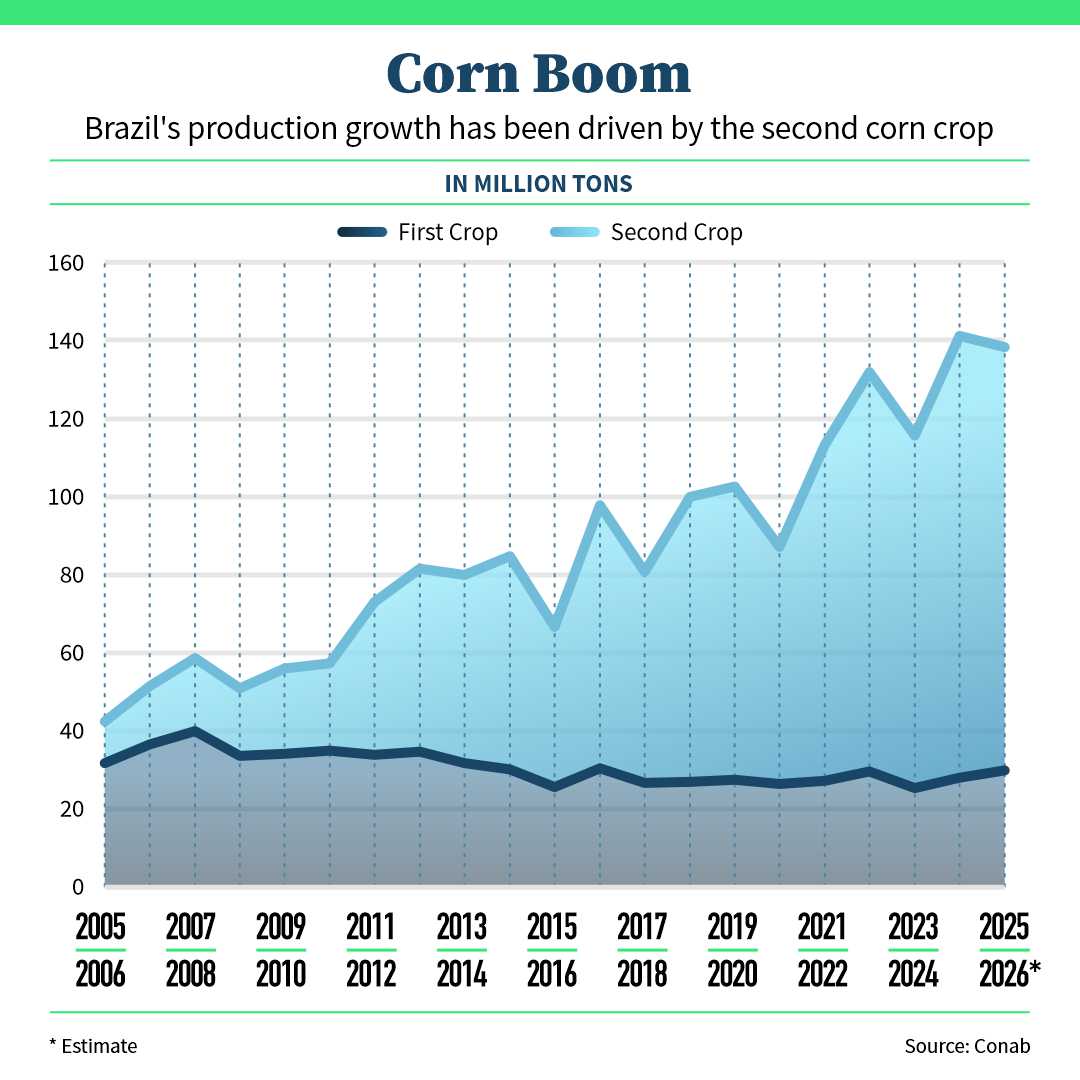
The findings also highlight other factors reducing emissions, including the use of renewable energy in ethanol plants and the widespread adoption of corn by-products to replace soymeal in animal feed — both widespread practices in Brazil.
One of those by-products, DDG — a high-protein residue from ethanol production — is expanding feed supply and freeing up both corn and soymeal for other markets, said Sofia Arantes, a researcher at Agroicone and co-author of the study.
“Feeding cattle with DDG allows producers to intensify output, producing more meat in less time,” she said.
Huge Potential
Brazil, the world’s largest soybean producer, has about 17 million hectares of established soy area suitable for second-crop corn, according to Bachion.
If fully directed to ethanol, it could boost Brazil’s corn ethanol output by as much as 38 billion liters, she said. That compares with an expected 10 billion liters of corn ethanol production this year, according to Conab.
The study also incorporates a high corn supply elasticity scenario, reflecting the country’s ability to expand output without significant new investment.
“Farmers don’t need strong price signals to increase second-crop corn production — the required investments are marginal, and the land is already in use,” Bachion said.
As a result, expanding ethanol production would likely have limited impact on prices while curbing emissions and easing concerns over food security, according to the study.


