


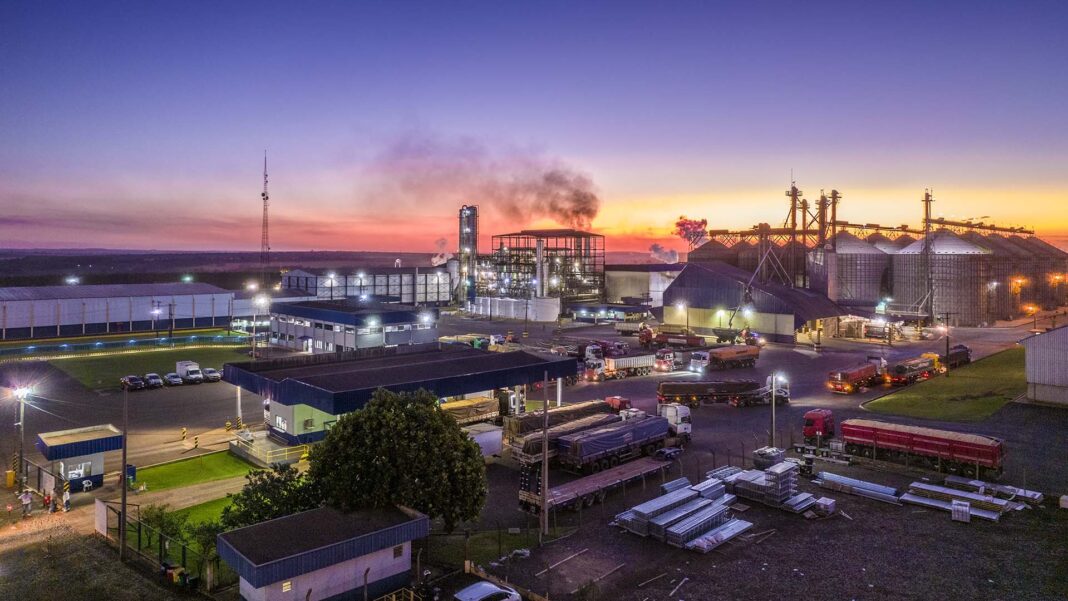

Inpasa, Brazil’s corn-ethanol market leader, is using its Paraguayan operations to make two products it does not produce in Brazil: biodiesel and sugarcane ethanol. The model gives the company a tax-advantaged export platform and access to local fuel mandates even as it directs its biggest expansion investments to Brazil.
Founded in Nueva Esperanza in 2006, Inpasa entered Brazil in 2017, following an unusual regional path: a Paraguayan company expanding into Brazil rather than the other way around. It now operates six plants in Brazil and two in Paraguay, with two additional Brazilian facilities under construction.
“Inpasa transformed Paraguay,” said Enzo Olmedo, director of Inpasa Paraguay. “Anyone in the country who drives a vehicle, eats meat or drinks a Coca-Cola is consuming something from Inpasa.”
Paraguay has no oil refineries and still imports all its fossil fuels, which helped shape Inpasa’s original business thesis, Olmedo said. The government was also signaling plans for ethanol-blending mandates; the country’s gasoline blend now ranges from 25% to 30%.
“We started with cassava ethanol, but it did not work,” Olmedo said. “We tried sugarcane and moved into sugar, which is now an important business. Then we saw that grains were the future of ethanol. It was a 10-year process of learning and maturing.”
Inpasa began producing corn ethanol in Paraguay in 2008 and later opened a second plant in São Pedro. Before selecting Brazil for its international expansion, the company considered Colombia, Bolivia and Argentina, Olmedo said.
Brazil Provides Scale
Inpasa’s six operating Brazilian plants are in Sinop and Nova Mutum, in Mato Grosso; Sidrolândia and Dourados, in Mato Grosso do Sul; Balsas, in Maranhão; and Luís Eduardo Magalhães, in Bahia.
Plants in Rio Verde, Goiás, and Rondonópolis, Mato Grosso, are under construction and scheduled for completion in the first quarter of 2027.
On corn ethanol alone, Inpasa produces 1.3 million liters a day in Paraguay and 16 million liters in Brazil. Once the new facilities are completed, its annual Brazilian capacity is expected to exceed 8 billion liters, up from 6.7 billion liters.
Olmedo attributed the pace of growth to a combination of efficiency, innovation and storage. Inpasa can source grain from as far as 500 kilometers (310 miles) away and store it for as long as a year, giving the company flexibility to manage raw-material costs.
Inpasa’s demand has also reshaped Paraguay’s corn market. Grain that was once almost entirely exported is increasingly consumed domestically by meatpackers and Inpasa.
The company alone uses just over 1 million metric tons of Paraguayan corn a year, equivalent to about 16% of the country’s nearly 6 million-metric-ton crop estimated for the 2025/26 season.
Across both countries, Inpasa generated $4.47 billion (22.8 billion reais) in revenue in 2025, with EBITDA of $1.43 billion (7.3 billion reais).
Biodiesel Tax Platform
In Brazil, Inpasa focuses exclusively on corn ethanol. In Paraguay, it also produces biodiesel at its São Pedro plant, using a corn-oil byproduct from the company’s corn-ethanol facility in Dourados.
Under Paraguay’s Maquila Law, which provides tax exemptions for export-oriented manufacturing, Inpasa imports the feedstock from Brazil duty-free and exports the resulting biodiesel without taxes, Olmedo said.
The company also plans to sell biodiesel in Paraguay’s domestic market as the country raises its mandatory biodiesel blend to between 8% and 10% starting in August 2026.
Inpasa produces 73 million liters of biodiesel a year. By comparison, Be8, Brazil’s market leader, produced 1.3 billion liters in 2025.
Combining corn-ethanol and biodiesel production has become increasingly common among Brazilian biofuel companies, particularly in the country’s Center-West region.
Cane Mandate Shapes Mix
Inpasa also produces sugarcane ethanol and sugar in Paraguay. Two laws enacted in 2024 require at least half of the ethanol used in fuel blends to come from sugarcane.
The measures are seen as a way to strengthen domestic agricultural production and protect Paraguay’s cane growers, most of whom are family farmers, as well as workers in the industry. A separate law enacted in 2025 set a 30% ethanol requirement for gasoline.
“It is a difficulty we manage as an opportunity,” Olmedo said of the rules.
The product mix also differs between the two countries. Anhydrous ethanol is blended into gasoline, while hydrous ethanol is sold as a standalone motor fuel.
Although the proportions fluctuate with short-term market needs, Paraguay typically produces about 90% anhydrous ethanol and 10% hydrous ethanol. Brazil’s mix is roughly 80% hydrous and 20% anhydrous, reflecting the widespread sale of hydrous ethanol directly to motorists.
Olmedo said Brazil remains Inpasa’s most immediate growth priority. Still, the company continues to assess opportunities in Paraguay because of advantages including taxes, labor costs and grain sourcing.
Any additional Paraguayan plant would need to be located near a port and dedicated entirely to exports to maximize the country’s tax advantages, he said.
This story was translated from the original Portuguese with the assistance of artificial intelligence and reviewed by The AgriBiz editorial staff.


