


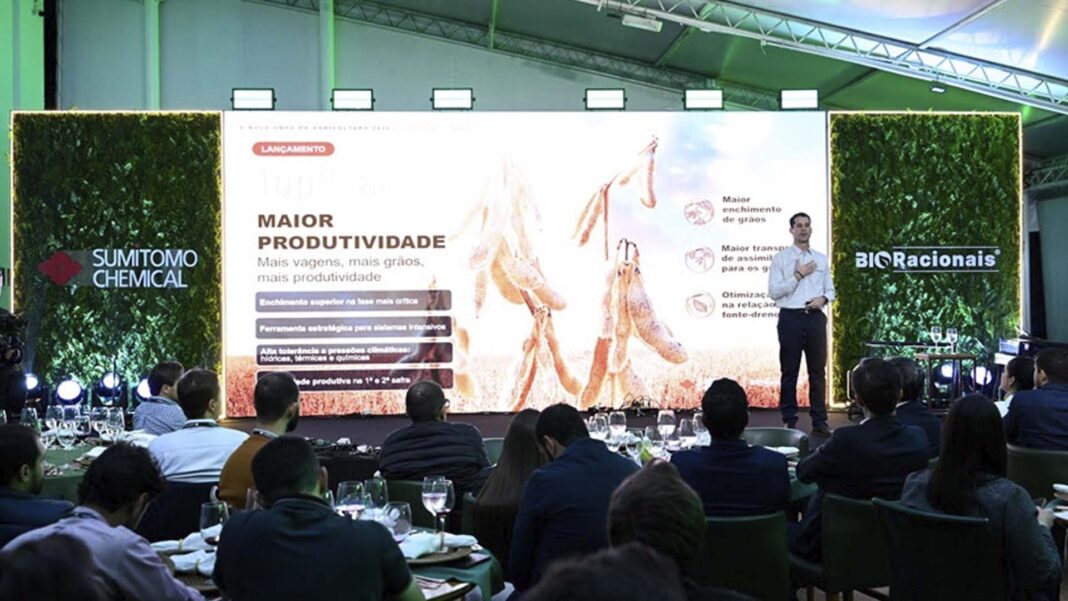

Sumitomo Chemical is introducing a new biological crop input in Brazil that it says can help soybeans and corn withstand adverse weather while delivering yield gains, as growers contend with tight margins and the prospect of an intense El Niño event.
The product, called TopGrain, is based on abscisic acid and is designed to support grain filling and help crops better express their yield potential. Sumitomo says it can add as much as three 60-kilogram bags per hectare — 180 kilograms per hectare, or about 161 pounds per acre — to soybean yields.
For corn, the company says the gain can reach seven 60-kilogram bags per hectare, equivalent to 420 kilograms per hectare, or about 375 pounds per acre.
The additional cost is less than the value of one bag per hectare for soybeans and slightly more than one bag for corn, Sumitomo said. In both cases, the net yield benefit is close to 5% compared with average Brazilian soybean and corn yields in the 2025/26 season, based on data from Conab, Brazil’s food supply agency.
The product is not intended to replace fertilizers but to complement them, Luciano Jaloto, Sumitomo Chemical’s marketing director in Brazil, told reporters in São Paulo during a global launch event.
“If fertilizer is the food, the biorational is like a vitamin that helps the plant absorb that food better and more efficiently,” Jaloto said.
Sumitomo also sees TopGrain as complementary to conventional crop-protection chemicals, an approach the company has emphasized as it expands its portfolio of so-called biorational products.
TopGrain comes as water-soluble granules and is designed to be applied alongside crop-protection products using the same farm machinery.
“Chemical products protect the plant against fungi, insects or weeds, while the biorational acts on the plant’s biology, helping it express more of its genetic potential,” said Alexandre Pires, Sumitomo Chemical’s general manager in Brazil.
The product is initially being introduced in the US, India and Brazil. Tropical growing conditions required additional adjustments and testing for the Brazilian market, according to the company.
TopGrain is currently manufactured in the US, though Sumitomo Chemical may eventually produce it in Brazil. The company also plans to develop versions for crops including sugarcane, cotton and fruit.
The launch adds to a biological portfolio that includes the Abgasil and ProGibb plant-growth regulators, the Xentari and DiPel bioinsecticides and the MycoApply biological inoculant. Sumitomo also plans to introduce its first biorational product for pasture areas.
Biologicals Gain Ground
Biorational products account for about 18% of Sumitomo Chemical’s revenue in Brazil, Pires said. Brazil in turn generates nearly 80% of the company’s biorational revenue in Latin America.
Sumitomo does not disclose investment specifically allocated to biorationals, but says the segment is a priority within its research and innovation spending, which typically amounts to about 7.5% of annual revenue.
The Brazilian market for biological crop inputs has expanded by about 15% a year over the past decade and by 21% annually over the past three years, said Henrico Bizão, Sumitomo Chemical’s biorationals manager in Brazil.
That growth has continued even as grain producers face squeezed profitability.
“Commodity prices are not historically bad, but high debt levels and expensive credit make the challenge worse,” Pires said.
Sumitomo is betting growers will continue to invest in products that can lift output enough to offset their additional cost rather than cut applications purely to reduce cash outlays.
In sugarcane, for example, adopting such crop-management tools can add four to seven metric tons per hectare — roughly 1.6 to 2.8 metric tons per acre — Pires said.
“It can be the difference between making money or not,” he said.
Sumitomo sees biorationals as a major avenue for growth after its Brazilian business generated about $795 million (4.1 billion reais) in revenue in 2025.
For 2026, the company expects revenue to increase by 7% to 8%, although Pires said the forecast has been changing frequently because of market volatility stemming from wars, high indebtedness and expensive credit.
By 2030, Sumitomo Chemical aims to double the size of its Brazilian operation.
This story was translated from the original Portuguese with the assistance of artificial intelligence and reviewed by The AgriBiz editorial staff.


